01 July 2026 · 6 min · By Jordan Foord
AI transformation is an operations problem. Not a tools problem.
The useful lesson from Notion's global AI report is not that everyone is behind. It is that most companies are still confusing tool access with operational change.
Notion’s latest State of Global AI Transformation report has a useful number for anyone feeling quietly behind: 88% of organisations are still in the early stages of AI transformation.
That should be comforting, but only briefly.
The point is not that everyone can relax. The point is that most companies are still mistaking AI activity for AI maturity: licences bought, tools approved, a few enthusiastic people experimenting, and a leadership team hoping this somehow turns into leverage.
It usually does not. Not without someone doing the dull operational work in the middle.
One caveat before we go further: this is vendor research, not scripture. But the pattern is useful because it matches what teams feel on the ground. Companies are not usually short of AI enthusiasm. They are short of operating discipline.
The gap is not enthusiasm
Notion surveyed 6,118 professionals across 10 markets between March and May 2026, including AI decision makers and everyday AI users. The report’s sharper finding is not just that adoption is early. It is that leaders and workers are experiencing two different transformations.
Notion says leaders are twice as confident as the workers using AI day to day. That gap matters because the worker’s version is usually closer to the operational truth.
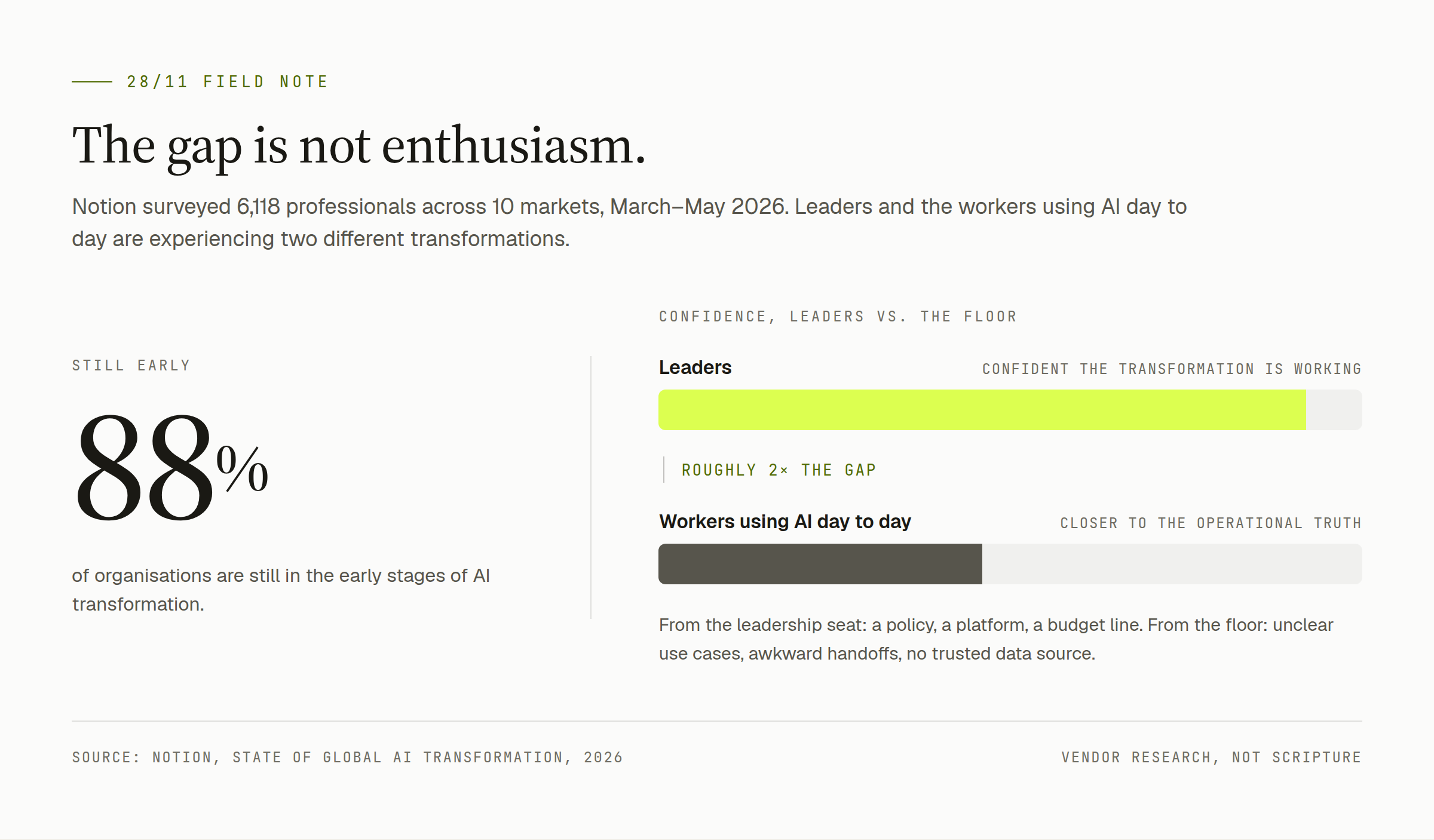
From the leadership seat, AI adoption can look like progress: the company has a policy, a platform, a budget line, maybe a few internal demos. From the floor, it can feel much thinner: unclear use cases, awkward handoffs, no trusted data source, and the same old workflow with a chatbot balanced on top like a hat.
This is where many AI programmes get stuck. Not because people dislike AI. Not because the models are useless. Because the organisation has not decided how the work should change.
Buying tools is the easy part
A lot of businesses are currently running the same playbook:
- Approve an AI tool.
- Tell the team it is available.
- Run a training session.
- Wait for productivity to appear.
- Wonder why usage is patchy.
This is not transformation. It is software distribution with better branding.
The hard question is not “which AI tool should we buy?”
It is “which workflow should be different by next month, and who owns that change?”
For a Singapore SME, that might mean sales follow-up, invoice handling, quote preparation, onboarding, weekly reporting, customer support triage, or document review. The workflow has to be specific enough that you can draw the current version, mark the waste, redesign the future version, and measure whether anything improved.
If you cannot do that, another tool will mostly add another tab.
A useful target sounds like this:
Supplier invoices under S$5,000 should be matched to the purchase order and receipt automatically, with exceptions on a finance review list by 3pm the same day. The metric is cycle time and rework rate. The human checkpoint is exception approval.
That is not a glamorous sentence. Good. It is specific enough to operate.
The three things advanced companies do differently
Notion’s report points to three implementation strategies that separate the more advanced organisations from everyone else: integration, governance, and measurement. That sounds like enterprise language, but the small-company version is practical.
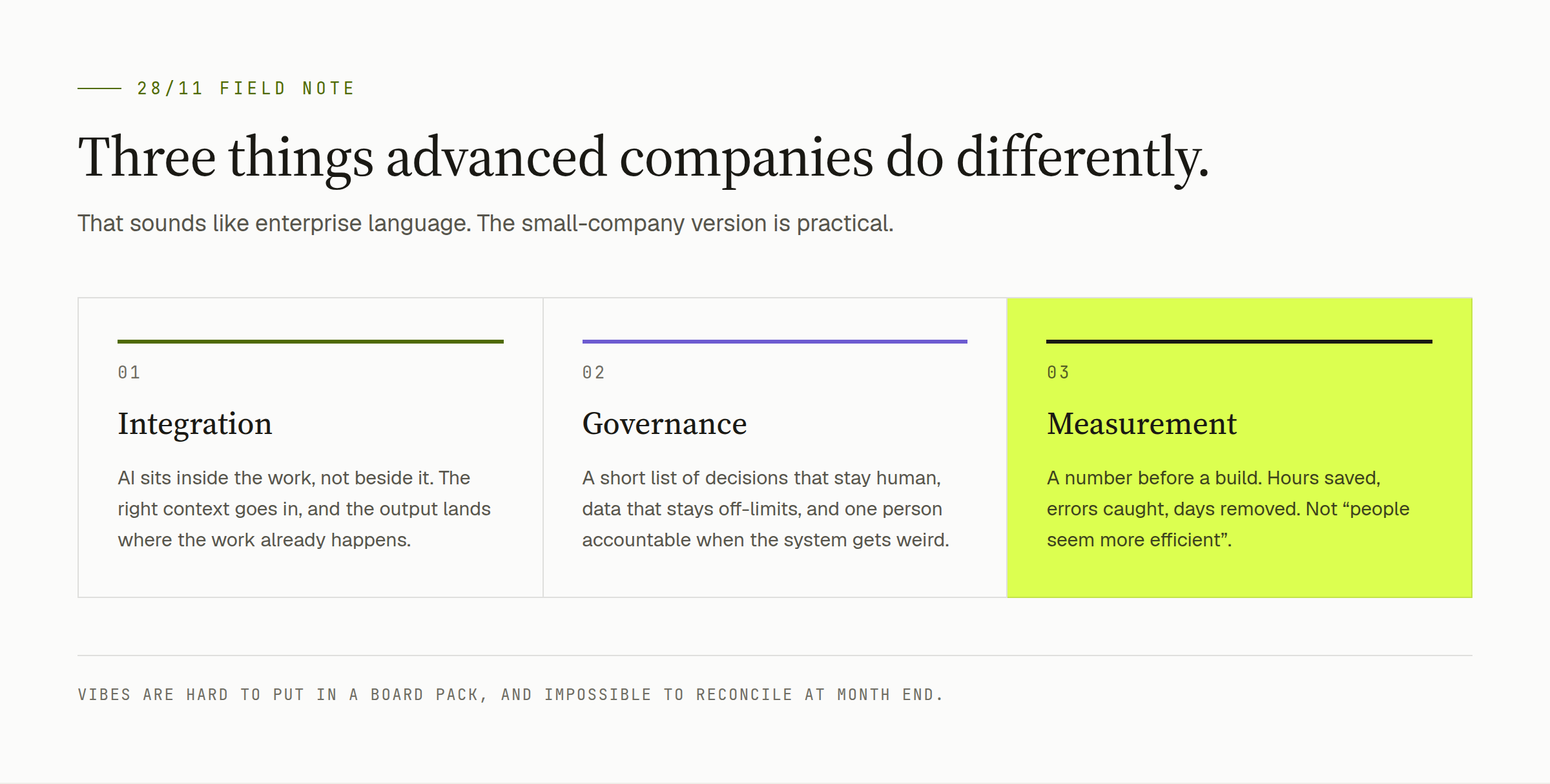
Integration means the AI sits inside the work, not beside it. If your team has to copy information from the CRM into a prompt, paste the answer into a spreadsheet, then ask someone on Slack whether it is correct, you have not integrated AI. You have created a new admin ritual. Integration means the agent or automation has access to the right context, returns output where the work already happens, and fits the existing approval path.
Governance means people know what AI is allowed to do. This does not require a 40-page policy. It requires a short list of decisions that stay human, data that must not be pasted into public tools, outputs that need approval, and one person accountable when the system gets weird. Which it will. All useful systems eventually get weird.
Measurement means a number before a build. Hours saved, response time reduced, errors caught, days removed from a reporting cycle, invoices processed without rework. Pick one. If the metric is “people seem more efficient”, you have bought vibes. Vibes are difficult to put in a board pack and impossible to reconcile at month end.
The audit should come before the agent
This is the mistake we see most often: businesses jump straight from “we should use AI” to “let’s build an agent”.
The missing step is the audit. Not a theatrical discovery workshop with 74 slides and a triangle called The Future of Work. A proper workflow audit.
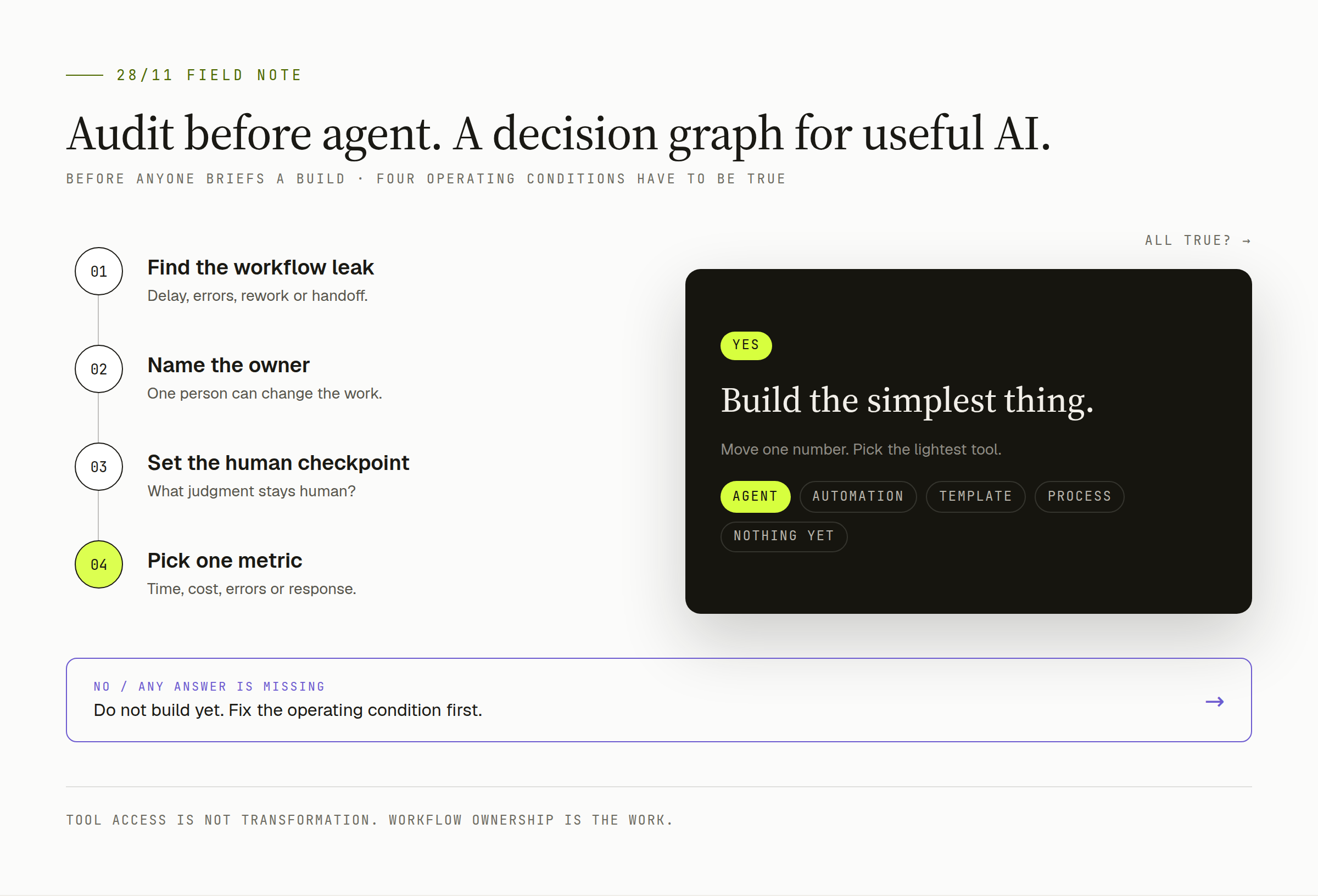
You look for priced leaks:
- where people repeat the same decision every week
- where information gets retyped between systems
- where a customer waits because an internal handoff is unclear
- where reporting exists because the source systems do not talk
- where senior people are doing low-judgement admin because nobody has redesigned the process
Then you rank those leaks by value, risk, and ease of deployment. Only then do you decide whether the answer is an agent, a simpler automation, a better template, a changed process, or nothing at all.
That last option matters. Sometimes the correct recommendation is “do not automate this yet”. The data is too messy, the process owner is absent, the judgement call is too exposed, or the team is not ready to operate the system after it ships. Saying no early is cheaper than pretending yes until the invoice has settled.
The honest cost: someone has to own it
AI transformation fails quietly when everyone thinks it belongs to someone else.
IT owns the platform. Leadership owns the ambition. The team owns the work. Finance owns the budget. A vendor owns the implementation. Somehow, nobody owns the Tuesday morning reality of whether the thing actually runs.
That owner does not need to be technical, but they do need to be named. They need to know the workflow, see the exceptions, watch the metric, and have authority to change the process around the AI.
This is where the work becomes less glamorous. Someone has to maintain prompts, update instructions, review edge cases, clean up source data, and decide when an automation should be paused. There is no serious AI operating model where everything is deployed once and admired forever. That is not an operating model. That is a shrine.
The good news is that smaller companies can do this faster than large ones.
Fewer committees. Shorter approval paths. Clearer view of where the pain is. If the owner is named and the metric is real, a small business can move from audit to working deployment while a larger company is still booking the steering committee pre-read.
What this means for Singapore businesses
Singapore companies do not need to wait for AI to become more mature before acting. The maturity gap is not mostly in the models. It is in the operating discipline around them.
The companies that move first will not be the ones with the longest AI tool list. They will be the ones that can say:
- this is the workflow we changed
- this is the number we moved
- this is the human checkpoint
- this is who owns it
- this is what we stopped doing because the agent now handles it
That is a much higher bar than “we have AI”. It is also a more useful one.
Do this next week
Pick one workflow that feels heavier than it should: sales follow-up, reporting, onboarding, invoicing, support triage, or document preparation.
Spend 45 minutes mapping it in four columns:
- What triggers the work?
- What information is needed?
- What decisions are made?
- What output proves the work is done?
Then mark every step that is repetitive, delayed by missing context, or dependent on someone copying information between systems.
Do not buy anything yet. Do not brief a developer yet. Do not ask ChatGPT to “make it efficient” and hope for the best.
First, find the leak. Put a rough dollar or hour value next to it. Name the owner. Decide the human checkpoint. Pick one number that would prove improvement.
If you can do that, you are no longer asking whether your company is “ready for AI”. You are doing the work that readiness actually means.
For a quick starting point, use our AI readiness score to pressure-test the basics. Or bring us one workflow through the contact page and we will tell you whether it is worth automating before anyone builds anything.